The Morning Lied

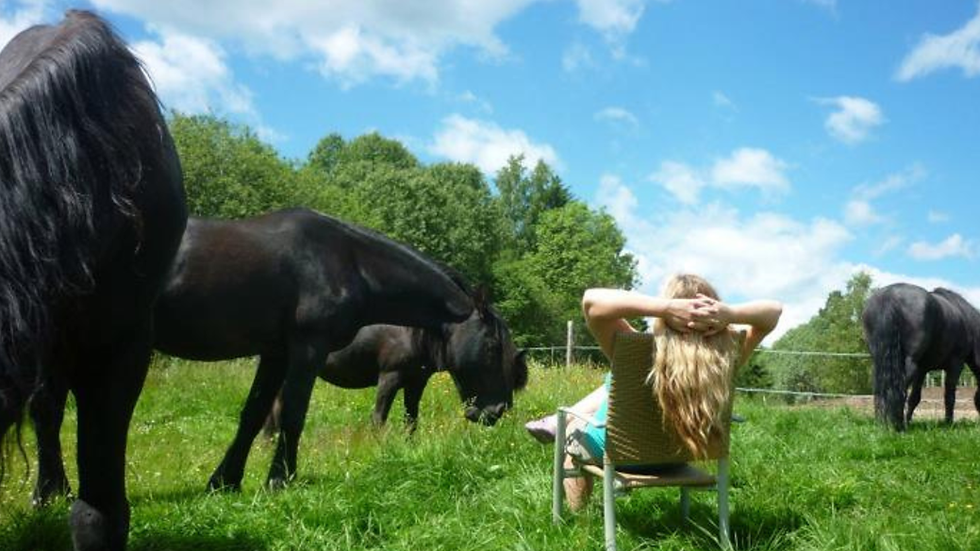
The sun was shining. The birds were doing that thing birds do in early summer where they sound genuinely thrilled to be alive. I woke up to what should have been an ordinary day, solstice, longest light of the year, the kind of morning that gets photographed and captioned with something about gratitude.
It was a trap.
By the time I'd had a proper look around, one of our horses was lying flat in the straw. Colic. If you don't know horses, here's the short version: a horse that lies down and won't get up is a horse that can die, and it can happen fast. So you do the things. Call the vet. Call the girls. Then you walk the pony, round and round, keeping her moving, keeping her here, because my daughters live half an hour away, and half an hour is a long time when something might die in front of you.
So there I was, out in the sunshine, walking a sick pony in circles and watching the road. And while I was doing that, Jan-Erik went to check on my father.
He'd arrived the day before in his campervan, already not feeling right. We had taken him to the doctor, where they found an infection and started him on antibiotics. My father, for his part, is convinced the real culprit was a hamburger he picked up somewhere on the road over. Food poisoning, he says. Maybe both. He's eighty, and at eighty nothing that knocks you sideways is a small thing.
Jan-Erik found him on the floor of the van. My father's legs simply wouldn't carry him. Jan-Erik got him up, into the bed, water, a little food. He said he wanted to rest, dizzy, nauseous, just needed to lie down.
There's a particular kind of vertigo in seeing my father like that, and I saw plenty of it before the day was done. This is the man who was, my whole childhood, the strong one. The one who lifted things and fixed things and carried me. And now he was the one on the floor, his own legs refusing to hold him, and some old role-reversal I always knew was coming arrived without knocking. I didn't have time to feel it properly in the moment, too much to do, a vet on the way, a pony to keep walking, but it sat in my chest the whole day, heavy and quiet.
The second time we found him, he'd tried to make it to the bathroom on his own and his legs had given out again. He couldn't get up. My father is a big man, around a hundred kilos, and getting him off the floor and back into the bed of a tiny campervan took every bit of strength Jan-Erik and I had between us. We managed it. And then we made the call. Ambulance. ER. That's where he is right now, as I write this.
So. Happy solstice.
Here's the thing I keep coming back to, and the reason I had to get this onto a page instead of just carrying it around in my chest like a stone.
From the outside, none of yesterday was visible.
If you'd driven past our place that morning, you'd have seen a pretty farm in the sun. Horses, flowers, the whole postcard version. You'd have had no idea a horse was fighting for her life in the paddock, or that an old man's body was quietly failing in a campervan parked beside the house. The cover of the book looked lovely. The pages were something else entirely.
We do this to each other constantly. We look at a person, composed, well-dressed, posting the nice photos, and fill in the rest with a story about how easy their life must be. Then we measure our own messy insides against their tidy outsides and come away feeling like we're the only one drowning.
But everyone's drowning a little. That's not pessimism, it's just arithmetic. Beauty doesn't exempt you. Money doesn't exempt you. Power doesn't exempt you. Your father's legs don't check your bank balance before they give out. Colic doesn't read the room. Life happens to you regardless of how good your lighting is.
I'm not telling you this so you'll feel sorry for me. I'm telling you because I think there's something almost relieving in it, if you turn it the right way round. The person you're envying is probably holding something heavy you can't see. And the person standing next to you, the one who looks fine, might be having the worst day of their year behind a perfectly calm face.
Which is the whole reason to be kind. Not the soft, greeting-card kind, the practical kind. The kind that assumes the stranger snapping at you in the queue might have just left a hospital. The kind that gives people the benefit of the doubt because you genuinely cannot see their pages, only their cover. The least we can do is handle each other gently, on the assumption that everyone is fighting something. Because everyone is.
This is a true story, and it was a genuinely brutal day. But here's the part I want to keep: we pulled together. Both my daughters showed up and took the old pony in hand. Jan-Erik was beside me through all of it, my father, the horse, everything else the day kept throwing. We did the next thing, and then the next thing, and somewhere in there the family became a single working organism. And that is its own kind of beautiful, not the postcard kind. The kind you can lean your whole weight on.
The pony's all right.
My father's in good hands.
And I'm sitting here, writing this in the long solstice light, reminding you, and myself, that the cover is never the whole book.
Don't judge yours by it. And for God's sake, don't judge anyone else's.


Comments