Dispatches From the Messy Middle (or: Why I've Gone Quiet)


I wrote a book about screwing the script, the one you were handed somewhere in your teens, and then I went and broke the first rule of selling it.

When you have something to sell, the experts say: "Show up consistently and feed the algorithm. At least three posts a week, a blog post, a reel, a story. CTA. Stay visible or disappear." So I disappeared, not because I gave up, but because I'm busy living what I write about, and right now I'm knee-deep in the messy middle.
We bought another farm. Yes, another one. It's called Solli, and its written history goes back to the 1600s, when herbs were grown here for the hospital in Oslo. The very rare henbane still grows here, along with four hundred apple trees, cherries, pears and plums. There's also a leaky old greenhouse. We've got big dreams for this place, and that comes with a pile of paperwork.
My partner and I are both closing in on sixty, and the kids have grown up and flown the nest. Instead of downsizing like sensible people, we looked at each other and said: We're not done learning yet. So here we are, scrambling up a very steep learning curve, one step at a time.
On a normal day right now I'm feeding someone, painting something, or trying to get our vision for Solli down on paper in a way the bureaucrats can understand. That means writing applications to the municipality, then rewriting them, then rewriting them again. The first step is getting Solli ready for farmstay guests, people who need a break from their busy lives (the irony isn't lost on me).
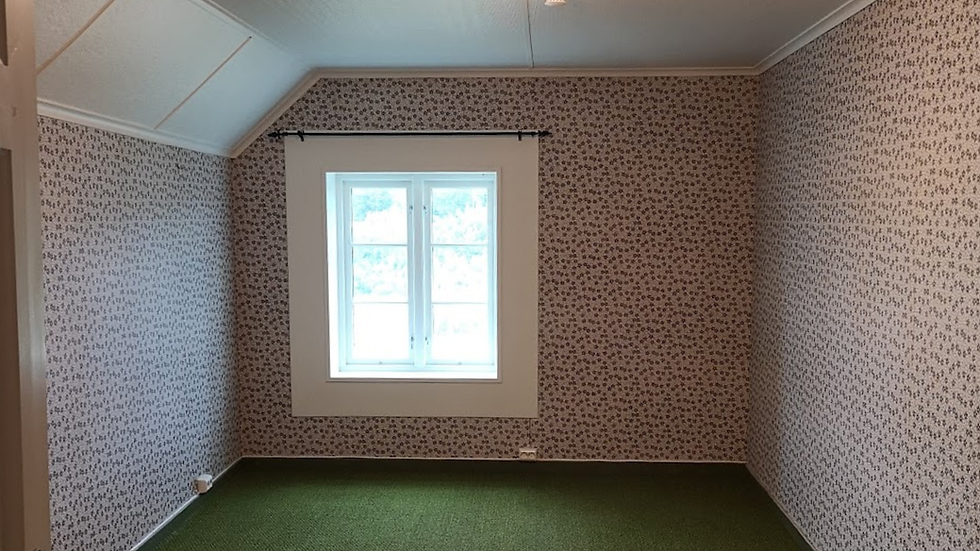
The main part of the farmhouse was built in 1790, solid and well kept, with thick timber walls, but the colours and floors are badly outdated. We're trawling the online marketplace for furniture and lamps, while learning to prune trees, grow chili, harvest fruit and make apple juice and hot sauce. The bigger plan for Solli is a story for another time, but trust me, it's fabulous.

And then, all of a sudden, the huge 17 000 m2 greenhouse on the neighbouring property presented an opportunity that's too good to pass up. The window is tight, so of course I have to make a plan for that too.
And that's just the farm we're moving to. The farm we're still living on hasn't exactly paused to let us go.
Every morning starts the same way, with four horses, nine alpacas and ten hens to feed, water and muck out. We adopted the hens this summer. They were worn-out layers headed for the gas chamber, because their working life was officially over. They arrived scruffy and nervous, but now they're glossy and happy, and laying eggs like their lives depend on it. Which, to be fair, they once did.
That brings me to my latest confession: We're drowning in eggs. Bowls of eggs, boxes of eggs, eggs in places eggs should never be. In the middle of everything else, we completely forgot to tell anyone we had eggs for sale. There's no better metaphor for this season of my life: abundance everywhere, and no time to put up a sign.
(So, locals, if you want eggs, call me. Please.)
Then there's the packing. Eighteen years of life in one place, with three biological children, five foster children and a whole parade of others who came to stay for a few days at a time, year after year. This house has held a lot of breakfasts, a lot of tears and a lot of growing up. Now they're all grown and gone, and every drawer is a small archaeological dig. I'm getting rid of things I've kept "just in case" for decades, things that belonged to a version of me I've outgrown. It's strangely freeing and strangely sad, sometimes in the same box.
And because this is Norway, winter is coming whether we're ready or not. The firewood is stacked and the water lines checked, the frost-sensitive plants are inside and the horses are in their rugs. The hay is stored, and the fences need fixing before the ground freezes.
The physical work is one thing, but the psychological side is another story. Right now we're carrying mortgages on two farms. Two. That's not a typo, and yes, I've done the maths more times than I'd like to admit, usually at 3 a.m. This summer we worked our socks off in the family business and built ourselves a buffer. I'm proud of that, because it was hard-won, sweaty and very unglamorous.
Still.
A buffer is a cushion, not a guarantee, and there's a quiet hum of pressure under everything right now. Every decision has a price tag, and every day is expensive. I'm not saying this for sympathy. I'm saying it because I think a lot of women my age are carrying something similar and pretending they aren't. Pretending is exhausting, and I'm done with it.
And no, the home we're leaving isn't being sold, at least not yet. My hope is that Villa Solsiden will carry on as a place where young people who've fallen through the cracks, and are struggling to find their way, can grow food, care for animals, fix what's broken and get back on their feet. It's simple, down-to-earth therapy, and it works like magic.
The messy middle doesn't look good on social media. The beginning is photogenic, with keys in hand, big plans and champagne. The end is photogenic too, with the ribbon and the before-and-after. But the middle is a dusty floor, a half-painted wall, a pile of forms, a counter full of eggs and a woman in an old jumper muttering at a spreadsheet. It's real work, slow and mostly invisible.
I used to think going quiet meant falling behind. I really do want to promote my book, because I believe in what it says, and the messages I get from readers tell me it’s landing exactly where it’s needed. But that nagging voice is the old script talking, the one that says: "Your worth is your output, and your output must be visible to count."
Some seasons are for building, not broadcasting.
In the next post, I'll share the six things keeping me sane in the middle of all this. They're straight from the book, tested in real life, with mud on them. But right now the horses are waiting, my coffee has gone cold, and the middle is calling.
Line


Comments