The House That Called My Bluff

RESTORING SOLLI
Dispatch One
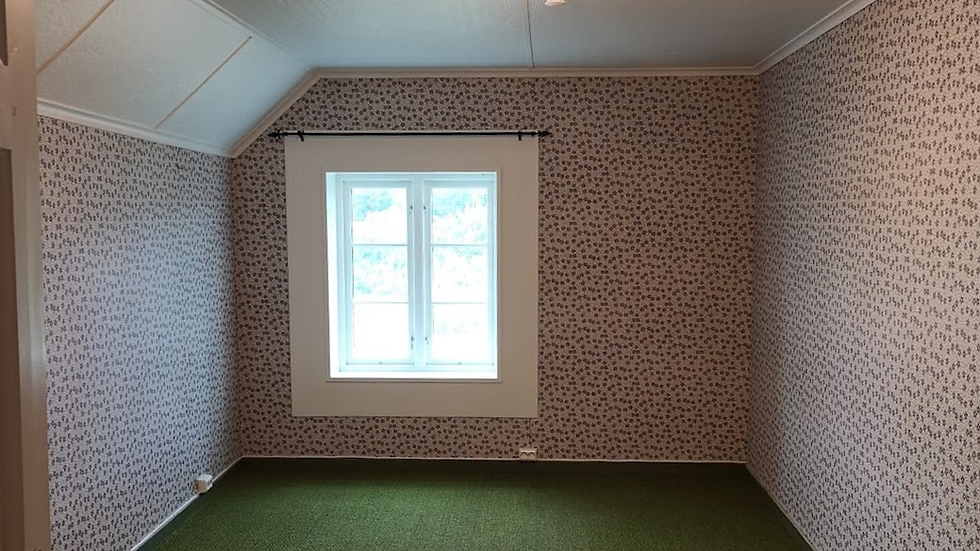
Yesterday I stood in a farmhouse built in 1790 and felt my heart drop straight through two hundred and thirty years of floorboards. Sound floorboards, I should say. Just very tired of whatever colour someone painted them in a decade I would rather not name.
I have spent years telling women that the messy middle is where the whole thing happens. That the moment it stops being a lovely idea and starts being real work is not the moment to run. I have put it in books. I believed every word, in the confident way you can believe a thing when it is happening to someone else.
Then I got the keys to Solli, walked into two hundred+ years of other people's lives, and my own advice looked me dead in the eye and said, go on then. Your turn.
Let me be honest about the feeling, because pretending it was excitement would make me exactly the kind of relentlessly positive woman this whole brand exists to annoy. It was not excitement. It was the distance. The distance between the house that is standing there right now, solid, dry, entirely fine, and dated to its back teeth, and the house I can see so clearly when I close my eyes. Every room works. Not one of them is beautiful yet. And beautiful, it turns out, is expensive and slow, and it was standing in front of me next to a man I love who was doing sums out loud while I quietly wanted to sit down on the floor and wait for the vision to arrive on its own.
Here is the thing I know, and knowing it did not make standing in that room any easier. That sinking is not a verdict. It is a receipt. It is what it costs to want something big enough to actually reach for it. Every woman I have ever coached hits this exact point and reads the sinking as proof she has made a terrible mistake. It is not proof of anything except that the thing is real now.
Take the floor. I had a picture in my head, the way you always do. Original pine under the ugly stuff, wide and honey-coloured and two hundred years old, waiting patiently beneath decades of bad taste for someone to come and love it. You strip away the ugliness and the beauty was there all along. It is a lovely story. It is more or less the story I sell.
The house had other plans, and it handed them to me one after another, like a series of small, well-aimed slaps. First: you cannot put chalk paint over vinyl wallpaper. It will not grip. The vinyl has to come off, every scrap of it, before anything lovely can go on the walls. Second: the ugly linoleum was laid before 1985, which is the polite way of saying it very probably contains asbestos, which means it does not come up on a wet Saturday with a scraper and a podcast. It comes up with professionals, in suits, at a price that made me sit down on a chair I do not even like. And third, the one that actually stung: when that floor finally comes up, what is underneath is not my honey-coloured dream. It is ordinary. It is fine. It is not the thing I pictured, and no amount of wanting is going to turn it into the thing I pictured.
So I compromise. I stop grieving the floor that never existed, and I go looking for the beautiful version of the floor that does.
That is the part nobody photographs. Renovation, like reinvention, is not the clean fantasy of peeling away the ugly to reveal the gorgeous truth that was hiding underneath all along. Sometimes you peel away the ugly and find more ugly, and a bill you did not budget for, and a floor that was never going to be the one in your head. The work is not uncovering the dream. The work is making something genuinely beautiful out of what is genuinely there, asbestos and disappointing floorboards and all.
There is a strange mercy buried in it, if I am honest. All week my head had been spinning over choices, paint and handles and textures and which of two nearly identical greens, a hundred open questions and no way to close a single one. The house has started answering them for me, and not gently. The linoleum is not a choice. The asbestos is not a choice. The floor I get is the floor I get. Fewer of these decisions turn out to be mine than I feared, and that is its own quiet relief, and its own quiet grief.
I teach this. I did not expect to be taught it back by a floor.
The tidy version of this story would start eighteen months from now, with soft light coming through a restored window and a caption about trusting the process. I am not going to do that to you, and I am not going to do it to myself. You do not need another woman showing you the after. You are drowning in afters. What almost nobody shows you is the day the person who wrote the book about the messy middle stood in her own messy middle and wanted to quit before lunch.
So this is the before. This is dispatch one, written the same night, while it still stings, because the sting is the honest part and I refuse to wait until I look like I had it handled all along. I did not have it handled. I am learning it in public, on purpose, and you get to watch.
Here is what we are actually building. Solli Gård is a farm outside Sandefjord, Norway, with a farmhouse from 1790, a garage and a greenhouse with a story I will save for another day, and roughly four hundred apple trees that do not care about my feelings and will fruit this autumn regardless.
Over the coming months we are going to make this house beautiful, room by room, on a budget that would make a sensible person laugh. Some of it we will get right. Some of it we will get wrong in ways I will report faithfully.
And at the end of it, this is a place you can come and stay. A working farm with rooms to sleep in, open to whoever wants a night somewhere old and beautiful and alive. Not a finished, styled, nothing-ever-went-wrong place. A place with a story you watched happen, run by a woman who let you see her heart sink and kept going anyway. That is the whole point. That has always been the whole point.
And maybe yours is not a farmhouse. Maybe it is the business you finally registered, the divorce papers, the blank first page, the move, the second act you talked about for a decade and have now, terrifyingly, begun. The heart-sink you are feeling is not the exit sign. It is the entrance fee. You are not doing it wrong. You are just, finally, doing it.
Come with me to Solli. I am going to make it beautiful, and I am going to let you see every unglamorous step it takes to get there.
Next time, the part nobody talks about: how on earth I'm paying for this.


Comments